Ongoing AMD Zen6 Rumors Continue to Suggest a 12-Core Single-CCD “Olympic Ridge” Processor Is Inbound for the AM5 Platform

Peter_Brosdahl

Moderator
Staff member
Joined
May 28, 2019
Messages
10,429
Reaction score
7,317
PC users are chomping at the bit to get an official update from AMD regarding Olympic Ridge, but ongoing rumors suggest good things are on the horizon.

See full article...
 
That's what the leakers/whateveryouwannacallem over on AT have been saying for months. The 12c CCD will be on an N2-class node, but there will be mobile CCDs on N3P that have Zen6c cores as well. I don't have all the configurations memorized. Some SKUs will mix N2 and N3P CCDs, including Medusa Halo.
 
10900X/X3D with 40 threads (two CCDs with 10 cores each) should end the x900X/x900X3D low sales volume curse that AMD has had to deal with so far, due to six cores per CCD not being good enough for gaming.
 
This would be fun to see... that and a 24 core 42 thread desktop processor.

Dang man, you lost 6 threads in that calculation. Maybe you should have ran it by AI first to find your mistake. LOL

All jokes aside, I am very interested in this. Especially if L3 cache scales with number of cores.

That 24 core, 48 thread processor with 96MB of L3 cache would be freaking awesome. And a X3D part with even more. Oh yes baby. Give me!
 
Dang man, you lost 6 threads in that calculation. Maybe you should have ran it by AI first to find your mistake. LOL

All jokes aside, I am very interested in this. Especially if L3 cache scales with number of cores.

That 24 core, 48 thread processor with 96MB of L3 cache would be freaking awesome. And a X3D part with even more. Oh yes baby. Give me!
Uhhh I was subtracting some for NPU's... yea.... that's the ticket!
 
What AMD really needs to focus on in the next generation is improving the fabric bandwidth situation so that it is no longer a bottleneck for RAM and PCIe bandwidth and latency.
 
This would be fun to see... that and a 24 core 42 thread desktop processor.

I feel like the many core consumer desktop thing is so overplayed at this point.

It was never interesting when it was new when Bulldozer first came out with 8 cores, and it isn't interesting today. Large numbers of cores are great for servers, especially hypervisors, and also for rendering/encoding type workstations, but for most desktop use they are utterly useless.

Especially since with dual channel RAM, the RAM bandwidth increasingly becomes the bottleneck with all of those cores vying for it.

Even our current 16 core top end consumer CPU's are probably too much for dual channel RAM.

The really interesting development here is not the potential for crazy core dual die consumer chips, but rather the 12 core variant with a single X3D cache that doesn't suffer from needing to get core parking right.

They need to be focusing much more on per thread performance, not just the cop out that is throwing more useless cores at CPU's. And to that end they need to solve the RAM latency and bandwidth limitation that the fabric connection to the I/O die causes.

I think chiplets are great, but we need them to communicate better. The fabric needs to be twice or three times as fast. Maybe that can be achieved through dual links or something? Instead of one 2000Mhz fabric link, what if we had dual 3000Mhz links?
 
Last edited:
I think chiplets are great, but we need them to communicate better. The fabric needs to be twice or three times as fast. Maybe that can be achieved through dual links or something. Instead of one 2000Mhz fabric link, what if we had dual 3000Mhz links?
Problem is, AMD likes keeping costs low. Zen 6 probably already has a new IOD but whatever enhancements they have made to it, we'll be stuck with that IOD till Zen 7 or even Zen 8. I could see them doing a 3000 MHz fabric but not dual ones. They don't care that much because Intel isn't competing like they should to force AMD to make better stuff. And the only way I see Intel forcing AMD's hand is to have their Nova Lake mainstream parts deliver at least +10% performance uplift over 14900KS in gaming.
 
Problem is, AMD likes keeping costs low. Zen 6 probably already has a new IOD but whatever enhancements they have made to it, we'll be stuck with that IOD till Zen 7 or even Zen 8. I could see them doing a 3000 MHz fabric but not dual ones. They don't care that much because Intel isn't competing like they should to force AMD to make better stuff. And the only way I see Intel forcing AMD's hand is to have their Nova Lake mainstream parts deliver at least +10% performance uplift over 14900KS in gaming.

Oh, you are probably right. I expect Zen6 to be an evolutionary improvement rather than a revolutionary one.

Fabric may be entirely internal to the CPU package, but it requires a lot of hooks in the BIOS, and if they mess too much with how the I/O Die communicates with the RAM, it may no longer be fully compatible with the AM5 pinout, voltage and current specs.

And even if it is, if you need to rewrite the BIOS too much to make it work, we are going to be right back in the bad place we were with AM4 needing a different BIOS for earlier CPU releases than for later CPU releases even if the motherboard is the same hardware-wise. I know AMD would rather avoid that if they have the choice, and if they aren't seeing too much pressure from Intel on the gaming front, they have no incentive to make their lives more difficult.

I haven't read any of the Panther Lake reviews/previews yet, but it looks like Intel is pushing for some pretty high official RAM clocks for them. I recently read a headline saying something about them targeting a minimum of DDR5 with 7467 MT/s minimum to allow partners to use for their Arc B series iGPU branding on Panther Lake systems. Of course, that's with the iGPU sharing the main system RAM which causes resource constrictions, so...

But back to AMD.

I can't speak at all to the cores per die thing, but I do expect them to nudge up the Fclk a bit, and maybe launch a new chipset that finally connects to the CPU using PCIe5, which might provide us more downstream options for chipset PCIe lanes for either PCIe slots or m.2 drives.

I did just invest in a Zen5 build I am not done building yet, but I'd totally welcome that.

 
I haven't read any of the Panther Lake reviews/previews yet, but it looks like Intel is pushing for some pretty high official RAM clocks for them.
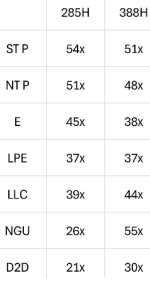
Someone shared this:

1770249870586.png

No idea about the source but if that's true, that's a pretty big jump for the NGU. That thing doesn't go above 34x for my 245KF so default being 55x in Panther and hopefully Nova Lake is going to be a big step in the right direction.
 
Someone shared this:

View attachment 4395

No idea about the source but if that's true, that's a pretty big jump for the NGU. That thing doesn't go above 34x for my 245KF so default being 55x in Panther and hopefully Nova Lake is going to be a big step in the right direction.

I'm not going to lie.

I have absolutely no idea what anything in that chart means 😅
 
I have absolutely no idea what anything in that chart means 😅
ST P: Max single thread frequency multiplier for P-core
NT P: Max multithread frequency multiplier for P-core
E: Max frequency multiplier for E-core
LPE: Max frequency multiplier for low power E-core
LLC: Not sure about this. My guess is that this is the ring bus frequency multiplier. But could also be last level cache or load line calibration.
NGU: Uncore frequency multiplier
D2D: Die to die interconnect frequency multiplier
 
ST P: Max single thread frequency multiplier for P-core
NT P: Max multithread frequency multiplier for P-core
E: Max frequency multiplier for E-core
LPE: Max frequency multiplier for low power E-core
LLC: Not sure about this. My guess is that this is the ring bus frequency multiplier. But could also be last level cache or load line calibration.
NGU: Uncore frequency multiplier
D2D: Die to die interconnect frequency multiplier
Ahh, OK.

Thank you for that.

Last consumer Intel CPU I had was Sandy-Bridge-E (i7-3930k) on an x79 platform I bought in 2011 and replaced with my Threadripper in 2019, so it has been a while.

I have a Rocket Lake Xeon (Xeon E 2314) on a Supermicro X12STL-F, but enterprise/server solutions are a little different, and I'm pretty sure that it is all P-Core.

I guess that's just a really long-winded way of saying that I'm not hip to the latest Intel consumer terminology.


Edit:

That's crazy come to think of it. I haven't actually bought an Intel desktop CPU in almost 15 years.

The Core I7-3930k was a beast, and I had overkill water-cooling on it, so I was able to hit 4.8Ghz. Both Ivy Bridge and Haswell had better IPC, but neither overclocked anywhere near as well, so it actually took until Skylake in 2015 before there was actually anything that I could buy that was faster.

...and you don't need to upgrade just because there is a faster CPU out there. By the time I felt I had an actual need for an upgrade (because I started getting CPU limited in Far Cry 4 even at 4k), Ryzen had already launched, and I just went with AMD from there on out. (though I decided to go with the Threadripper in 2019) The Ryzen 7 1800x beat the I7-6900k in productivity, but it lost slightly to the Core i7-7700k in gaming, and shortly after AMD caught back up when it came to gaming.
 
Last edited:
Last consumer Intel CPU I had was Sandy-Bridge-E (i7-3930k) on an x79 platform I bought in 2011 and replaced with my Threadripper in 2019
SImilar for me as well, at least when it comes to my desktop setups. I had a 4930K which was replaced by a 3700x in 2019. I know a big difference in terms of the AMD parts but otherwise, I've been running AMD desktop CPUs since and see no reason to change anytime in foreseeable future. My AM5 build is prime and ready for these new Zen6 processors so I'm just sitting and waiting.

On the flipside, I still use Intel with my laptops but that's mainly been because I simply cannot source AMD-based laptops with the GPUs I want, or at least a a price I can afford. Meanwhile I'll say the 13900HK I have in one, and the Core Ultra 275 in the other are absolute beasts and I've been very happy with them.
 
On the flipside, I still use Intel with my laptops but that's mainly been because I simply cannot source AMD-based laptops with the GPUs I want, or at least a a price I can afford.
9955HX is the first DTR AMD CPU I've seen easily available for me locally. I think the X3Ds have raised AMD's profile in the DIY market so much that even diehard Intel sellers are making more AMD options available. However, the 275HX is available roughly for the same price with a 5070 than the 9955HX with a 5060.
 
Become a Patron!
Back
Top