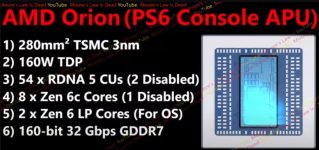
Next PlayStation and Xbox Consoles Are Rumored to Feature AMD UDNA/RNDA 5 Graphics

GAS, specifically streaming, which I am looking forward to, can be quite hardware independent. Funny in a way I ended up nintendo precisely because I wanted to ' own ' games. I 'own' all my ds/3ds games, they are there still working, still owned, same with wii games, same with * most* switch games. Yes the switch gets an * , games in that console can be cartrige, download, or even fake cartrige, which is really a download, same as its done ps5, ps4 , ps3? idk, same microsoft.
I dropped pc gaming way back then unquestionably because ownership was taken away ( via server/ serial activation), which meant I lost most of my games I had accumulated late 90s, early 2000s ( all with proper serial numbers, I confess I did not understand the concept of activation - of course they worked when new- didnt know it was a server/ remote thing, I thought it was a cd/ local thing) I tought i ' owned ' those games, same as one would a game cartrige, provided a proper os, it should work I thought, but all i had was a much of useless cd roms. I moved to ps3, to wii ( ds I had for handheld) Meanwhile I watched everyone and their dog make Gabe Newell a multibillionare while not owing any games, everyone ever so happy, so which ownership?
You selling those steam games lately? Can you even sell your account?
I own my 3ds games a hell of a lot more than you ever will any game at Steam.
Hell, I think some have gone up in price.

If nintendo wants to port every single game every single time they make new hardware, thats good on them. I dont have to buy it, I have never purchased what I already own, theres no point for me.
Off memory, miitopia was made for 3ds, then later , ported to the switch, yay! Got it for the switch, never did for the 3ds, If I did, why would I buy it again on the switch? No one makes you buy nintendo.. I mean if you are a collector of all things nintendo, then yeah you would buy, and good on you , whatever.
Plenty of non intendo games have ' editions' releases (they did in the past for sure, not paying attention now) and then you add collections, and bundles and so on, sucks for you if you got the first version, now you can have the dlc, or re buy the bundle or the platimum edition or whatever; well just like nintendo, no one makes you buy it. Yes i know theres some studio that release big updates with new features, but looking at the news its almost like a bribe, for initially releasing a buggy incomplete alpha software.
Oh yeah, i am looking forward for GAS/ streaming, to just cut off hardware purchase. For now, I will keep looking, that will be my ' second' console most likely, no rush for me. But yeah, I am looking forward a netflix of games, and then a bunch of lesser netflixes to checkout, maybe hop on and off here and there.
 
Funny in a way I ended up nintendo precisely because I wanted to ' own ' games. I 'own' all my ds/3ds games, they are there still working, still owned, same with wii games, same with * most* switch games. Yes the switch gets an * , games in that console can be cartrige, download, or even fake cartrige, which is really a download, same as its done ps5, ps4 , ps3? idk, same microsoft.
Thing that would make me stop buying consoles is the removal of physical media support, backwards compatability is great but not if you can't play the games you already own due to no disc player in the console.
 
being portable is a huge plus
Don't have to sell me on portable gaming. My first console was the original Game Boy (cuz the Atari 2600 was my mother's, as was the NES). My mom was big into Nintendo handhelds and our family used to collect Game Boys. We had original Game Boys, Game Boy Colors, Game Boy Pocket, and Game Boy Advances (including SP, but not the stupid tiny Micro). We also had Game Gear, DSes, PSP, and 3DSes. I'm still trying to get my hands on a PS Vita. After I soft-modded my 3DS it became one of my most-used systems. My bro and I both have Switches, and he spends a lot of time on his Steam Deck. I have a friend who rarely gets to play video games at home, so most of his gaming is done when he is out and about, or on break at work. His Switch and Steam Deck have been invaluable for that.

As far as nintendo re releasing the game in different generations, this is a good thing, you dont have to buy it if you played it, why would you? I would buy it if I havent played it though.
Yeah, that makes sense, but that's not what I take issue with. The problem is that they re-release games for full price, even when they are old as f*ck. And yeah sometimes they'll add a little bit of content or make other changes, but not enough to warrant the games still being full price after so many years.

Graphics are way over rated in terms of providing the fun part of games, like super over rated.
Gameplay is always the most important thing about a video game. Doesn't matter how good the game looks if it still plays like @ss, and is no fun to play. But Nintendo has forgotten what it was like to have the most powerful system on the market, like back with the SNES or N64, or at least have decent hardware like the Gamecube. The power of the SNES made a lot of sh1t possible, and improved experiences in very meaningful ways. After Gamecube their hardware has been holding back their games, rather than setting them free, and allowing them to realize more of their potential and give the player the best experience possible.

Funny in a way I ended up nintendo precisely because I wanted to ' own ' games. I 'own' all my ds/3ds games, they are there still working, still owned, same with wii games, same with * most* switch games. Yes the switch gets an * , games in that console can be cartrige, download, or even fake cartrige, which is really a download
With GOG purchases on PC you fully own the games. Anything that is DRM-free, even on other platforms (for example, CP2077 is still DRM-free on Steam). But I get what you are saying. I'm really big into physical media, and that's one thing I am glad consoles still do. I was never happy that it stopped being a thing on PC. But on PC where we used a lot of "community demos" we were already amassing libraries of digital-only games, so when stores like Steam started officially doing it, it wasn't that big of a deal to a lot of PC gamers. But yeah on consoles I try to buy as many games as possible physically rather than digitally.

As for PC games that aren't DRM-free, well the community is always around to provide free versions of those games anyways. I wouldn't feel guity if I lost access to a game I "owned" on a digital storefront cuz the store closed down, and I replaced that copy with a "community demo". Heck, I've already done something similar on consoles: when my copy of Mario Kart DS was stolen, I didn't buy another copy. I just used the "community demo" version from then on.

I still have pretty much all the physical games I've ever had for all systems I've owned since the NES. I keep all my consoles (most of which are still hooked up and ready to play) and games, rarely sell any games. What I really like to do is have soft-modded systems, so I can have the physical discs or cartridges, but don't actually need to use them to play the games. Like when my Wii got soft-modded I still bought games, but I would use those discs to install the games to the HDD I was using for my Wii. Then I would just load the games off the HDD, but I was happy to still have the physical discs. Same for my PSP, I own UMDs but I load ISOs from the memory card. Same thing for when I soft-modded my DS and 3DS. I have the physical cartridges but I don't need to put them in the systems to play those games. You can extract the ROM and save data from the cartridges you own. Makes it safer when you travel around with your system, cuz you don't have to carry the games with you. This is a lesson I learned the hard way after I got robbed in 2010 and they stole my first DS Lite and left me with only one physical game for the system. I lost not only the games but the save data on those games. My entire NES library was also stolen in the 90s and in the 2000s I replaced most of those games, and then expanded my library further.

Don't forget that some Switch 1 games only have part of the game on the cartridge, cuz developers were too cheap to use the full cartridge size cuz those cost more (for Switch 1 the largest size is 32GB). So in the cases of those games, the cartridges are not stand-alone, and won't work without downloading the rest of the game. Kinda defeats the purpose of physical media. Or in the case of game collections, only part of the collection is on the cartridge. So for example the Spyro Reignited Trilogy only has the first of the 3 games on the cartridge. The other two games are downloads. So if you own the cartridge and try to play it 20 years from now on a fresh system long after the Switch servers were shut down, you're SoL if you wanna play Spyro 2 or 3 in that collection, unless you already have the data on-hand.

And then yeah for Switch 2 those fake red cartridges that are called "key cards" or whatever is just straight-up a stupid f*cking idea.

But we're the weird ones for liking physical media, cuz most people seem to prefer digital libraries (and not just for games but even for movies and music). I even have friends who think it is too much trouble to get up, walk over to the console, and put in/take out a game! Kinda ridiculous if you ask me. But as someone who has been using consoles since 2nd-gen and still regularly plays consoles across all generations, having to physically change out games is something that is still normal to me.

That being said, I do wish I had flashcarts for multiple systems, so I could just load an SD card or whatever full of game ROMs, stick it in a flashcart like an Everdrive, stick the flashcart in the system and then just load up the games. It's certainly cost effective for platforms like the Neo-Geo, where the games have insaaane costs, and where I feel emulation isn't good enough to just stick to that. For reference I own a Neo-Geo MVS (the arcade version, not the home console version which is the AES). I f*cked around with Neo-Geo emulation and it's not good enough for me, so I stick to the hardware. At least I have the MVS cuz games for the AES tend to cost waaaaay more (and MVS games are already expensive). I have friends who own a lot more MVS games (and one of them has a flashcart), so I just borrow their games rather than buying my own (but I still have a decently sized library of my own).

I own my 3ds games a hell of a lot more than you ever will any game at Steam.
Yes this is true (if you're not counting DRM-free games on PC), and it is true for any console where you get the actual full game on a cartridge or optical disc. But if you had bought your 3DS games digitally then you would be in the same boat as on any other platform with digital games. You get the same options as you do on Sony and Microsoft systems - buying the physical copy or buying the digital copy. So that doesn't make Nintendo special.

My brother often mentions how he misses the days when consoles has no OSes and no user accounts and you just popped the game in, turned the system on, and the game was already running, and you could play it immediately.

If nintendo wants to port every single game every single time they make new hardware, thats good on them. I dont have to buy it, I have never purchased what I already own, theres no point for me.
That's fine, I'm just saying Nintendo shouldn't overcharge for them, which they always f*cking do.

And some of those ports to newer systems are worse than the original versions, or worse than what is available elsewhere. Like Super Mario Sunshine in the Super Mario 3D All-Stars collection is worse than the original version on Gamecube (but Super Mario Galaxy is better than the original Wii version, except for the color banding issues with the graphics). As for Super Mario 64 in that collection, the native PC port is vastly superior. And that PC version was ported to both 3DS and Wii U (and Switch), and even on 3DS it is superior. So Nintendo charging actual money for crappier versions of their own games that are available elsewhere is another thing I have a problem with.

Thing that would make me stop buying consoles is the removal of physical media support, backwards compatability is great but not if you can't play the games you already own due to no disc player in the console.
Which is really f*cking annoying. I have an XB1 and use it to play some X360 and original Xbox games (sadly not all the original Xbox and X360 games I have work on XB1). I was thinking about grabbing an XBSS to replace my XB1, but without an optical drive, I have no way of putting in the discs for those X360 or original Xbox games. So XBSS ends up being useless to me for that purpose.

Oh yeah, i am looking forward for GAS/ streaming
I'm the opposite. I don't believe in streaming video games. That sh1t needs to run on local hardware. And Games as a Service, ugh no thank you. I want to buy a game once for a reasonable price and then keep it and use it forever. Game Pass is not for people like me. And kinda useless in the modern age where games often get to really cheap prices rather quickly. That being said, I did try streaming games on a friend's XBSX and it worked out pretty well (although visually it was quite lacking, with lower IQ and full of artifacts), but my friend lives in close proximity to both Verizon FiOS backbone and Microsoft's servers for that area, so he said what I experienced is better than how the service normally is.
 
cuz most people seem to prefer digital libraries (and not just for games but even for movies and music)
Actually it's even worse than that, cuz I keep running into people who don't even have local digital libraries, they stream movies/shows and especially music. Just insane to me that people can live like that. If I don't use BDs then I at least have BD rips. And for music, shiat I still grab CDs then rip them to FLAC. I don't stream anything (aside from watching YouTube). I play everything from local media whether I am in my home or in my car or wherever else (from my PC, my phone, a flash drive, etc). My car is too old, but I wish I had a newer system and head unit so I could do like a lot of my friends and just throw music onto a flash drive and plug that in and just leave it in the car. I do throw music on my phone, but to play it out of my car's radio I have to use a casette tape adapter.
 
GAS, specifically streaming, which I am looking forward to, can be quite hardware independent. Funny in a way I ended up nintendo precisely because I wanted to ' own ' games. I 'own' all my ds/3ds games, they are there still working, still owned, same with wii games, same with * most* switch games. Yes the switch gets an * , games in that console can be cartrige, download, or even fake cartrige, which is really a download, same as its done ps5, ps4 , ps3? idk, same microsoft.
I dropped pc gaming way back then unquestionably because ownership was taken away ( via server/ serial activation), which meant I lost most of my games I had accumulated late 90s, early 2000s ( all with proper serial numbers, I confess I did not understand the concept of activation - of course they worked when new- didnt know it was a server/ remote thing, I thought it was a cd/ local thing) I tought i ' owned ' those games, same as one would a game cartrige, provided a proper os, it should work I thought, but all i had was a much of useless cd roms. I moved to ps3, to wii ( ds I had for handheld) Meanwhile I watched everyone and their dog make Gabe Newell a multibillionare while not owing any games, everyone ever so happy, so which ownership?
You selling those steam games lately? Can you even sell your account?
I own my 3ds games a hell of a lot more than you ever will any game at Steam.
Hell, I think some have gone up in price.

If nintendo wants to port every single game every single time they make new hardware, thats good on them. I dont have to buy it, I have never purchased what I already own, theres no point for me.
Off memory, miitopia was made for 3ds, then later , ported to the switch, yay! Got it for the switch, never did for the 3ds, If I did, why would I buy it again on the switch? No one makes you buy nintendo.. I mean if you are a collector of all things nintendo, then yeah you would buy, and good on you , whatever.
Plenty of non intendo games have ' editions' releases (they did in the past for sure, not paying attention now) and then you add collections, and bundles and so on, sucks for you if you got the first version, now you can have the dlc, or re buy the bundle or the platimum edition or whatever; well just like nintendo, no one makes you buy it. Yes i know theres some studio that release big updates with new features, but looking at the news its almost like a bribe, for initially releasing a buggy incomplete alpha software.
Oh yeah, i am looking forward for GAS/ streaming, to just cut off hardware purchase. For now, I will keep looking, that will be my ' second' console most likely, no rush for me. But yeah, I am looking forward a netflix of games, and then a bunch of lesser netflixes to checkout, maybe hop on and off here and there.
How cute thinking you own your games. You don't own your games; you licence the right to play the games you pay for. The fact you have physical media is irrelevant. It's been like that for as long as I can remember. Thing is it's now easier to block you from playing the game if you violate the licence agreement.
 
I dropped pc gaming way back then unquestionably because ownership was taken away
And with nintendo you don't even own the HW, they will literally brick it remotely if you do something they don't approve of. You call that ownership?
You selling those steam games lately? Can you even sell your account?
My exact point was that I want games that I wouldn't want to sell. I never sold a PC game in my entire life, even when that was still possible.
Ownership to me is not about how can I make money on flipping games. It means I get to keep it and access it whenever I want.

This is in part why I despise streaming services, I don't want to pay for something that turns into thin air as soon as I stop paying.
Even in the Satellite TV era, I only paid for services where I could record unencrypted streams. And on the internet and On demand video, I only accept the deal if I can save the stream.

I'd pay for a subscription service if it let you keep games indefinitely, but we both know that's never gonna happen.
 
Last edited:
The last console generation I was heavily invested in was 7th-gen. I had all 3 consoles but I focused the most on my X360. I practically lived on the thing. That was the last console I spent a great deal of time on.

Pretty much the same here. PS3/X360 were so much of a drastic improvement over earlier generations it was unreal. Since then.... just generational upticks in resolution, the games seem the same.

How many 360's did you go through? I had FIVE (but only purchased 2) due to RROD. Last one was a Jasper and it was the only stable one. I don't know how MS came out of that gen as the "winner" they were replacing so many dead units.

Something truly amazing needs to happen to make a new generation special. Just "MOAR REZ" to 4K+ isn't cutting it. VR wasn't it. I don't know what it will take. Perhaps portable is the way. I had a Vita, was cool but barely used it. I now have a PS Portal, and while I admit it is pretty cool, I barely use it.

Maybe a new generation of VR can do it. I just don't know. Also I am getting a case of "the olds" and don't have nearly as much time or desire to play or around as I did 20 years ago.

I'm trying to remember the last console game that really had me sucked in.... and I think it was Ace Combat 7 on PS4 with a HOTAS setup. I also did play CP2077 but did it streaming on the google thing, I could have just as easily played it on PC (and at stage in it's patch cycle, still buggy AF)
 
How many 360's did you go through? I had FIVE (but only purchased 2) due to RROD. Last one was a Jasper and it was the only stable one. I don't know how MS came out of that gen as the "winner" they were replacing so many dead units.

I believe I had multiple original design 360s (had to get a RROD replacement once or twice). I remember doing a 'towel' trick to temporarily fix one of my 360s and it actually worked. Only for a few weeks, mind you, but it worked.

I also had a 360 'Slim' variant (or whatever they called it) and that thing was solid for years.

Something truly amazing needs to happen to make a new generation special. Just "MOAR REZ" to 4K+ isn't cutting it. VR wasn't it. I don't know what it will take. Perhaps portable is the way. I had a Vita, was cool but barely used it. I now have a PS Portal, and while I admit it is pretty cool, I barely use it.

I'm hoping it's going to be a end of 'walled gardens' or a loosening of the walled gardens. Would love if there were only timed exclusives, and no exclusives for multiplayer focused games.

I'd also hope that all of the console manufacturers offer a portable or 'hybrid' version of their console. With all the rumors about a Playstation handheld (and with MS partnering with ASUS on a handheld) I'm thinking that will be a thing we'll see next gen. If they do go that route, I hope they also have some 'portable-only' features/software for the handheld platform. It was kinda silly, but I enjoyed Vita's 'Near' app or the DS equivalent 'Mii-something'.

Personally, I've been enjoying my PS5 alot recently. Kinda ironic in that I typically gamed on my desktop PC; Picked up a Steam Deck and really enjoyed the experience of playing games through its interface (slick gamepad friendly with suspend/resume), but am now finding myself gravitating towards console instead of playing on my desktop. I'm sure if Valve ever gets around to releasing a standalone console or I end up building myself a dedicated linux gaming box - that would be my main gaming platform.
 
How many 360's did you go through? I had FIVE (but only purchased 2) due to RROD.
I bought my Xbox 360 Elite (which I believe has a Falcon board) in Spring 2008. In 2012 this happened:


After these videos were taken, I finally got the error: E74. That's not even remotely the same issue as RRoD. RRoD was covered in a free extended warranty. E74 was not. So I had to pay outta pocket for Microsoft to fix my system. But it's been working fine since.

I also had a 360 'Slim' variant (or whatever they called it) and that thing was solid for years.
Ah yes, the Model S or whatever it was called. My brother has that one. Never had any issues with it. He also has a soft-modded original model X360 (not sure what motherboard is in his unit) that he's also never had issues with.

I don't know how MS came out of that gen as the "winner" they were replacing so many dead units.
Their development tools and dev environment were far superior to what was available on the PS3, as well as the hardware design being more friendly to devs, so most devs (even Japanese ones) coded their games for X360 first, then ported over to PS3. As a result a lot of PS3 versions didn't turn out as well as the X360 versions.

Have you ever seen this documentary series?
Chapter 5 covers the RRoD from the Microsoft perspective.

I'm hoping it's going to be a end of 'walled gardens' or a loosening of the walled gardens. Would love if there were only timed exclusives, and no exclusives for multiplayer focused games.
Same.
 
I think at $1k, console gaming goes entirely to Nintendo. That, or the Xbox S edition makes a comeback.

I know inflation is a thing and stuff costs more, but hitting that 4-digit barrier, when consoles used to cost half that... I don't think it will do well. Just look at how the PS3 did when it initially tried to release as a premium-and-premium-priced console.

Current non-pro console is about $500. And we do always see the scalpers come out to play when they first release, so I could see Sony/MS trying to get a piece of that and having a higher release price, with subsequent discounts once the sales die off. But I can't really see them going up to $999+ - that's double the current price - at least without a lot of backlash and consequences.

(I'd say PC becomes an option, but you aren't building a comparable PC Gaming platform for $1k either anymore)
 
for those who love to read about patents — a fun collection of AMD patents

  • AMD has filed and been granted 20+ patents focused on next-generation GPU technologies, strongly emphasizing ray tracing performance, efficiency, and smarter workload scheduling.
    • These patents suggest major architectural upgrades aimed at future RDNA or UDNA GPUs and possibly next-gen consoles.
  • Ray tracing and geometry improvements
    • Advanced ray tracing techniques including payload sorting, deferred any-hit shaders, and fine-grained context saving.
    • New geometry systems like Dense Geometry Format, Displaced Micro Meshes, and improved tessellation for higher visual detail at lower cost.
  • BVH and intersection optimization
    • Multiple patents target faster ray traversal using improved BVH structures.
    • Techniques include mass culling of BVH nodes, low-precision or integer-based intersection testing, and pre-filtering to reduce expensive calculations.
  • Smarter GPU scheduling
    • Heavy focus on Work Graphs–centric scheduling.
    • GPUs gain more autonomous control over task dispatch, load balancing, and shader execution, reducing CPU overhead.


20+ Ray Tracing, Scheduling, and other AMD patent grants and filings, hinting at future GPUs and gaming technologies​


https://www.reddit.com/r/GamingLeak...&utm_medium=post_embed&utm_content=action_bar

https://www.neogaf.com/threads/20-r...-future-gpus-and-gaming-technologies.1692390/


  • AMD has filed and been granted 20+ patents focused on next-generation GPU technologies, strongly emphasizing ray tracing performance, efficiency, and smarter workload scheduling.
    • These patents suggest major architectural upgrades aimed at future RDNA or UDNA GPUs and possibly next-gen consoles.
  • Ray tracing and geometry improvements
    • Advanced ray tracing techniques including payload sorting, deferred any-hit shaders, and fine-grained context saving.
    • New geometry systems like Dense Geometry Format, Displaced Micro Meshes, and improved tessellation for higher visual detail at lower cost.
  • BVH and intersection optimization
    • Multiple patents target faster ray traversal using improved BVH structures.
    • Techniques include mass culling of BVH nodes, low-precision or integer-based intersection testing, and pre-filtering to reduce expensive calculations.
  • Smarter GPU scheduling
    • Heavy focus on Work Graphs–centric scheduling.
    • GPUs gain more autonomous control over task dispatch, load balancing, and shader execution, reducing CPU overhead.
Click to expand...


#1 Patent list - Ray tracing/RT, execution and payload sorting

  1. https://patentscope.wipo.int/search/en/detail.jsf?docId=US464433976 (Fine grained context saves)
  2. https://patentscope.wipo.int/search/en/detail.jsf?docId=US464434024 (Shader Engine HW payload coalescer)
  3. https://patentscope.wipo.int/search/en/detail.jsf?docId=US464434039 (Enhanced resource barriers)
  4. https://patentscope.wipo.int/search/en/detail.jsf?docId=US464435335 (Animated curved surface patches)
  5. https://patentscope.wipo.int/search/en/detail.jsf?docId=US464435300 (Deferred any hit shaders)
  6. https://patentscope.wipo.int/search/en/detail.jsf?docId=US464101855 (High quality animated Displaced Micro Meshes/DMMs)
Sourced from

#2 Patent list - BVH related

  1. https://patentscope.wipo.int/search/en/detail.jsf?docId=US470469751 (Interpolated geometry + Dense geometry format/DGF)
  2. https://patentscope.wipo.int/search/en/detail.jsf?docId=US470603545 (DGF + DMMs/subdivision surfaces)
  3. https://patentscope.wipo.int/search/en/detail.jsf?docId=US470603544 (DGF without indices (implied))
  4. https://patentscope.wipo.int/search/en/detail.jsf?docId=US470469793 (Dual use BVH for RT and collision detection)
  5. https://patentscope.wipo.int/search/en/detail.jsf?docId=US470469794 (Mass culling/discard of BVH nodes)
Sourced from

#3 Patent list - DGF + OBBs + Pre-filtering (low precision/INT-based parallel intersection testing)

  1. https://www.patents-review.com/a/20250111586-pre-filtering-nodes-bounding-volume-hierarchy.html (DGF BVH fallback + Pre-filtering)
  2. *https://www.patents-review.com/a/20250131640-intersection-testing-dense-geometry-data-triangle.html (DGF + Pre-filtering)
  3. *https://www.patents-review.com/a/20250131639-dense-geometry-format.html (DGF description)
  4. https://www.patents-review.com/a/20...w-precision-ray-intersection-accelerated.html (Quantized BVH data for Pre-filtering)
  5. https://www.patents-review.com/a/20250209723-system-method-low-precision-ray-tests.html (Pre-filtering)
  6. https://www.patents-review.com/a/20...s-oriented-bounding-boxes-based-platonic.html (Quantized/INT-based OBBs)
Sourced from

* = #2 and #3 mentioned previously by Kepler_L2 here

#4 Patent list - Work Graphs-centric scheduling

  1. https://patents.google.com/patent/US20240111574A1 (Shader Engine autonomous scheduling (WGS) and dispatch (ADC))
  2. https://patents.google.com/patent/US12153957B2 (Hierarchical work scheduling and load balancing)
  3. https://patents.google.com/patent/US20240111575A1 (WGS to Command Processor communication scheme)
  4. https://patents.google.com/patent/US20240202003A1 (Fixed-function/FF + Work Graphs)
  5. https://patents.google.com/patent/US12436767B2 (Two FF pipeline modes)
  6. https://patents.google.com/patent/US20250217195A1 (WGP-level autonomous scheduling and dispatch)
Sourced from
 
work graphs can be expected to be significantly important for all next gen GPUs & consoles


https://overclock3d.net/news/gpu-di...mance-gains-using-work-graphs-with-radeon-gpu
https://developer.nvidia.com/blog/advancing-gpu-driven-rendering-with-work-graphs-in-direct3d-12/
https://developer.nvidia.com/blog/work-graphs-in-direct3d-12-a-case-study-of-deferred-shading/
https://github.com/NVIDIAGameWorks/donut_examples/tree/main/examples/work_graphs
https://overclock3d.net/news/softwa...ure-could-make-future-games-less-cpu-limited/

With the proliferation of GPU-driven rendering techniques – such as Nanite in Unreal Engine 5 – the role of the CPU is trending towards primarily resource management and hazard tracking, with only a fraction of time spent generating GPU commands. Prior to D3D12 Work Graphs, it was difficult to perform fine-grained memory management on the GPU, which meant it was practically impossible to support algorithms with dynamic work expansion. Even simple long chains of sequential compute work could result in a significant synchronization and memory overhead.

GPU-driven rendering was accomplished by the CPU having to guess what temporary allocations were needed by the GPU, often over-allocating to the worst case, and using previous frame readback for refinement. Any workloads with dynamic expansion either meant issuing worst case dispatches from the CPU, having the GPU early out of unnecessary work, or non-portable techniques were used, like persistent threads.

With Work Graphs, complex pipelines that are highly variable in terms of overall “shape” can now run efficiently on the GPU, with the scheduler taking care of synchronization and data flow. This is especially important for producer-consumer pipelines, which are very common in rendering algorithms. The programming model also becomes significantly simpler for developers, as complex resource and barrier management code is moved from the application into the Work Graph runtime.

We have been advocating for something like this for a number of years, and it is very exciting to finally see the release of Work Graphs.

DX12 with the latest Agility update supports them but it will be a good while before games start using them as they have to be built with this rendering method in mind.

Researchers Unveils Real-Time GPU-Only Pipeline for Fully Procedural Trees

by AleksandarK Jun 23rd, 2025 18:24 Discuss (34 Comments)
A research team from Coburg University of Applied Sciences and Arts in Germany, alongside AMD Germany, introduced a game-changing approach to procedural tree creation that runs entirely on the GPU, delivering both speed and flexibility, unlike anything we've seen before.

Showcased at High-Performance Graphics 2025 in Copenhagen, the new pipeline utilizes DirectX 12 work graphs and mesh nodes to construct detailed tree models on the fly, without any CPU muscle.

Artists and developers can tweak more than 150 parameters, everything from seasonal leaf color shifts and branch pruning styles to complex animations and automatic level-of-detail adjustments, all in real-time. When tested on an AMD Radeon RX 7900 XTX, the system generated and pushed unique tree geometries into the geometry buffer in just over three milliseconds. It then automatically tunes detail levels to maintain a target frame rate, effortlessly demonstrating stable 120 FPS under heavy workloads.


traditional buffer-heavy approach might need tens of GB, but researcher's demo holds onto just 51 KB of persistent state per frame. A scratch buffer of up to 1.5 GB is allocated for work-graph execution, though actual usage varies by GPU driver and can be released or reused afterward.

Static assets, such as meshes and textures, remain unaffected, leaving future opportunities for neural compression or procedural texturing to further enhance memory savings.


Widespread adoption will take time since current support is limited to AMD's RDNA 3+ and NVIDIA's 30-series and newer GPUs. Full game-engine integration and console support are still on the horizon. Looking forward, the researchers are exploring how to extend this flexible, GPU-driven pipeline into ray tracing, possibly by building on-GPU bounding volume hierarchies with the same work-graph framework.


AMD researchers reduce graphics card VRAM capacity of 3D-rendered trees from 38GB to just 52 KB with work graphs and mesh nodes — shifting CPU work to the GPU yields tremendous results​


Trees aren't the only objects that can be rendered with this paradigm. We can expect other objects, and possibly even textures, to be rendered this way in the future. Nvidia is already working on neural texture compression to reduce texture demands on video memory, but work graphs and mesh nodes provide another method of achieving the same goal (and will not be limited to Nvidia GPUs).

https://www.tomshardware.com/pc-com...cpu-work-to-the-gpu-yields-tremendous-results
 
for those who love to read about patents — a fun collection of AMD patents

  • AMD has filed and been granted 20+ patents focused on next-generation GPU technologies, strongly emphasizing ray tracing performance, efficiency, and smarter workload scheduling.
    • These patents suggest major architectural upgrades aimed at future RDNA or UDNA GPUs and possibly next-gen consoles.
  • Ray tracing and geometry improvements
    • Advanced ray tracing techniques including payload sorting, deferred any-hit shaders, and fine-grained context saving.
    • New geometry systems like Dense Geometry Format, Displaced Micro Meshes, and improved tessellation for higher visual detail at lower cost.
  • BVH and intersection optimization
    • Multiple patents target faster ray traversal using improved BVH structures.
    • Techniques include mass culling of BVH nodes, low-precision or integer-based intersection testing, and pre-filtering to reduce expensive calculations.
  • Smarter GPU scheduling
    • Heavy focus on Work Graphs–centric scheduling.
    • GPUs gain more autonomous control over task dispatch, load balancing, and shader execution, reducing CPU overhead.


20+ Ray Tracing, Scheduling, and other AMD patent grants and filings, hinting at future GPUs and gaming technologies​


https://www.reddit.com/r/GamingLeak...&utm_medium=post_embed&utm_content=action_bar

https://www.neogaf.com/threads/20-r...-future-gpus-and-gaming-technologies.1692390/


#1 Patent list - Ray tracing/RT, execution and payload sorting

  1. https://patentscope.wipo.int/search/en/detail.jsf?docId=US464433976 (Fine grained context saves)
  2. https://patentscope.wipo.int/search/en/detail.jsf?docId=US464434024 (Shader Engine HW payload coalescer)
  3. https://patentscope.wipo.int/search/en/detail.jsf?docId=US464434039 (Enhanced resource barriers)
  4. https://patentscope.wipo.int/search/en/detail.jsf?docId=US464435335 (Animated curved surface patches)
  5. https://patentscope.wipo.int/search/en/detail.jsf?docId=US464435300 (Deferred any hit shaders)
  6. https://patentscope.wipo.int/search/en/detail.jsf?docId=US464101855 (High quality animated Displaced Micro Meshes/DMMs)
Sourced from

#2 Patent list - BVH related

  1. https://patentscope.wipo.int/search/en/detail.jsf?docId=US470469751 (Interpolated geometry + Dense geometry format/DGF)
  2. https://patentscope.wipo.int/search/en/detail.jsf?docId=US470603545 (DGF + DMMs/subdivision surfaces)
  3. https://patentscope.wipo.int/search/en/detail.jsf?docId=US470603544 (DGF without indices (implied))
  4. https://patentscope.wipo.int/search/en/detail.jsf?docId=US470469793 (Dual use BVH for RT and collision detection)
  5. https://patentscope.wipo.int/search/en/detail.jsf?docId=US470469794 (Mass culling/discard of BVH nodes)
Sourced from

#3 Patent list - DGF + OBBs + Pre-filtering (low precision/INT-based parallel intersection testing)

  1. https://www.patents-review.com/a/20250111586-pre-filtering-nodes-bounding-volume-hierarchy.html (DGF BVH fallback + Pre-filtering)
  2. *https://www.patents-review.com/a/20250131640-intersection-testing-dense-geometry-data-triangle.html (DGF + Pre-filtering)
  3. *https://www.patents-review.com/a/20250131639-dense-geometry-format.html (DGF description)
  4. https://www.patents-review.com/a/20...w-precision-ray-intersection-accelerated.html (Quantized BVH data for Pre-filtering)
  5. https://www.patents-review.com/a/20250209723-system-method-low-precision-ray-tests.html (Pre-filtering)
  6. https://www.patents-review.com/a/20...s-oriented-bounding-boxes-based-platonic.html (Quantized/INT-based OBBs)
Sourced from

* = #2 and #3 mentioned previously by Kepler_L2 here

#4 Patent list - Work Graphs-centric scheduling

  1. https://patents.google.com/patent/US20240111574A1 (Shader Engine autonomous scheduling (WGS) and dispatch (ADC))
  2. https://patents.google.com/patent/US12153957B2 (Hierarchical work scheduling and load balancing)
  3. https://patents.google.com/patent/US20240111575A1 (WGS to Command Processor communication scheme)
  4. https://patents.google.com/patent/US20240202003A1 (Fixed-function/FF + Work Graphs)
  5. https://patents.google.com/patent/US12436767B2 (Two FF pipeline modes)
  6. https://patents.google.com/patent/US20250217195A1 (WGP-level autonomous scheduling and dispatch)
Sourced from

brief overview of the patents here


Patents attempt a clean slate rework of ray tracing pipeline and scheduling and doing things smartly (conserving resources) rather than mindlessly throwing silicon at the problem. Some other stuff sprinkled in as well.

Most of the RT patents tackle two issues: Bounding volume hierarchy (#2) and ray traversal (#3).
The BVH side builds upon the existing Dense Geometry Format and implements a hardware DGF decompressor. They further extend that by pairing subdivision surfaces/tesselation with DGF to allow some insane reductions in BVH build time and footprint. To make traversal of very wide BVHs feasible a patent implements a smart method of tagging nodes (boxes within boxes) in a BVH at build time (precomputed) and when traversing BVH with each ray. This reduces traversal overhead a lot. There's also a patent about using the same BVH structure for ray tracing and collision detection (physics).

The scheduling patents tailor scheduling and execution to the Work Graphs API, which isn't surprising given the previous technical lead for the entire Work Graphs effort at AMD, Matthäus Chajdas, is listed on all of them (#4). Here's his LinkedIn.
However, this doesn't mean only applications and games using the Work Graphs API should benefit. If implemented all applications should benefit. It's a really solid foundation and patents even suggest they permit Zen-like chiplet GPUs (less data movement/data locality focused) and arbitrarily wide GPUs designs (excellent core scaling and load balancing).
There's also two patents that focus on enhanced execution.

The last patent implements hardware payload sorter within each Shader Engine that runs concurrently with the producer and consumer nodes in the Work Graph. It is a superior implementation the current way of sorting (more efficient/faster) on a per CU basis which is far from optimal.

In total there is 23 patents of which 14 are Ray tracing related, 8 are scheduling and execution related, and 1 is related to data sorting. This is not anywhere close to a complete picture of AMD's GPU related patents. There's +100 with potential relevancy for future HW gens with more appearing at least on at least a quarterly basis. It'll be interesting to see how many of these patents end up in future generations.
 
a brief write-up on recent discovery of a collection of AMD (next-gen) patents


Out of 23 recently highlighted patents, fourteen target ray tracing performance, eight focus on GPU scheduling and execution, and one addresses on-chip data sorting.

Rather than treating ray tracing as a standalone feature, AMD appears to be redesigning the entire pipeline—from geometry storage to task scheduling—to reduce wasted computation.

Implications of AMD GPU Patents for Future Radeon GPUs

If these patents translate into real hardware, they would represent a meaningful architectural shift. AMD would be moving ray traversal into dedicated hardware, reducing memory traffic through Dense Geometry Format acceleration, enabling smarter API-driven scheduling at the silicon level, and laying the groundwork for more scalable chiplet-style GPU designs.

If successful, this could allow AMD to close the performance gap without needing dramatically larger or more expensive chips.

Taken as a whole, the filings suggest AMD is pursuing a coordinated redesign of its ray tracing pipeline rather than isolated experiments. The ideas revolve around reducing data movement, avoiding unnecessary calculations, and dynamically balancing workloads across GPU cores. By sharing structures between ray tracing and physics, filtering out unnecessary rays early, and making scheduling more intelligent, AMD could improve performance without simply increasing transistor counts.
 
a brief write-up on recent discovery of a collection of AMD (next-gen) patents


Out of 23 recently highlighted patents, fourteen target ray tracing performance, eight focus on GPU scheduling and execution, and one addresses on-chip data sorting.

Rather than treating ray tracing as a standalone feature, AMD appears to be redesigning the entire pipeline—from geometry storage to task scheduling—to reduce wasted computation.

Implications of AMD GPU Patents for Future Radeon GPUs

If these patents translate into real hardware, they would represent a meaningful architectural shift. AMD would be moving ray traversal into dedicated hardware, reducing memory traffic through Dense Geometry Format acceleration, enabling smarter API-driven scheduling at the silicon level, and laying the groundwork for more scalable chiplet-style GPU designs.

If successful, this could allow AMD to close the performance gap without needing dramatically larger or more expensive chips.

Taken as a whole, the filings suggest AMD is pursuing a coordinated redesign of its ray tracing pipeline rather than isolated experiments. The ideas revolve around reducing data movement, avoiding unnecessary calculations, and dynamically balancing workloads across GPU cores. By sharing structures between ray tracing and physics, filtering out unnecessary rays early, and making scheduling more intelligent, AMD could improve performance without simply increasing transistor counts.
Both AMD and nvidia (and intel for that matter) have thousands of patents that never come to anything. like for example 3dfx patents which only served for nvidia to stop its legal battle with 3dfx but never used them on any of their cards.
 
Become a Patron!
Back
Top