The OLED Black Depth Lie – When Panel Type and Coating Matters

Peter_Brosdahl

Moderator
Staff member
Joined
May 28, 2019
Messages
10,574
Reaction score
7,463
Just putting this here. I know we have more than a few display junkies out there, myself included and it's commonly known that folks have their own preferences.

This is a very long read but I do recommend it.
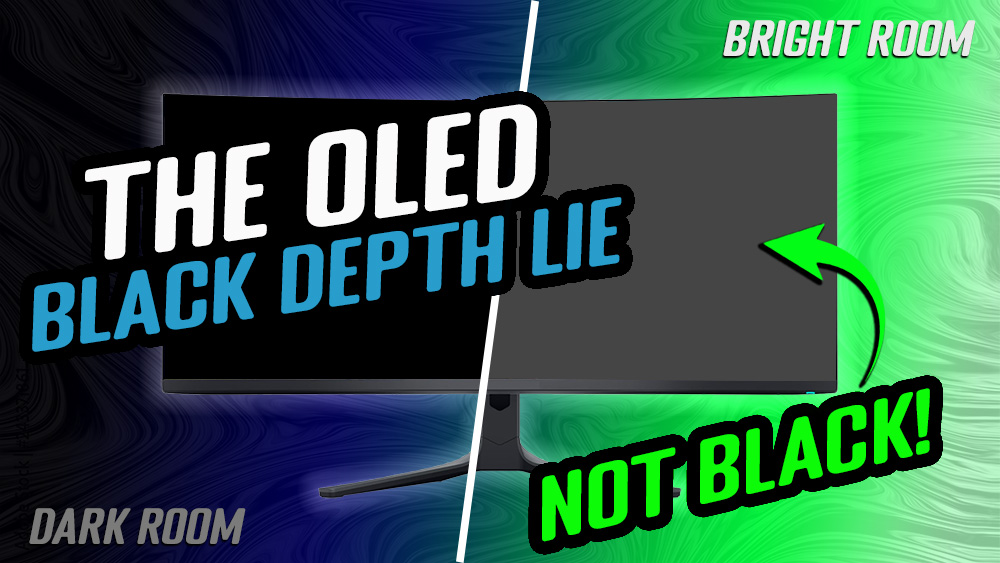
 
That is an interesting read. They are comparing "perceived black", which incorporates whatever effect ambient lighting is having on the panel as well. Quantum Dots react strongly with ambient light - I hadn't thought about that, but it makes sense. And it makes Samsing QD-OLED panels fare worse than VA and not much better than good IPS monitors.

It's hard to TLDR that article, they shotgun a lot of data out there.

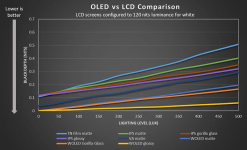
This graph would be for most of your current generation LG screens (non-QD)

1701625480535.png

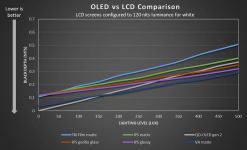
This one current generation QD-OLED - they use the same scale.

1701625665134.png

I will say, even though this graph clearly shows Glossy screens fairing better for perceived black - I hate trying to watch on glossy screens, because any amount of ambient lighting turns them into a mirror. It makes sense though, if you are measuring the effect of ambient light, a glossy screen is going to be the least impacted.

They do state at the end in their TL;DR (which is quite lengthy in and of itself and hard to parse without getting into the context up above) - that all the OLEDs were actually displaying true black - These graphs are just illustrating the effect of the ambient lighting and how it affects the screen and what we see sitting back on the couch. And this is just looking at that "black level" we see, it isn't looking at things like max brightness, color fidelity, HDR quality, features, etc. So just a very narrow, ver very detailed view at one aspect of monitor panels.
 
Just putting this here. I know we have more than a few display junkies out there, myself included and it's commonly known that folks have their own preferences.

This is a very long read but I do recommend it.

Very good read. Thank you for sharing.
 
Well I mean checking out microcenter there are some 48 inch OLED monitors going for 800 bucks... teeeemmmppppttttiiiinnnnnggggg..
 
I prefer glossy for entertainment but fully agree that once enough light/reflections come into play it's game over. I like matte for work and situations with brighter lighting. However, if enough ambient light comes into play then even matte begins to look horrible to me.
 
I had my 48" CX and the 42" C2 on my desk and it was just a bit overbearing so I moved the 48" to another room, and got the Alienware 34" AW3423DWF QD-OLED on sale, and honestly I really like it to the point where it's my main gaming monitor now. I'm surprised how nice the display is compared to the C2.
 
I did come up with a way to sort of summary this:

TN has the worst black levels - under pretty much all conditions.

IPS beats out TN, and VA beats out IPS, and WO OLED (LG) beats out VA = again, under pretty much all conditions.

All of the above panels, more or less, follow the same slope when it comes to perceived darkness as ambient light increases.

QD OLED (Smasung) though - it can look better than VA under low light levels, but it quickly gets worse as light levels increase. At moderate light it's no better than average and under bright light it can actually look worse than most IPS. This is the outlier in that it's perceived darkness level degrades much faster with respect to ambient light than other panel technologies.
 
Two stories that should overall be good news for OLEDs:


Yeah, can't wait for the new models start appearing this year, particularly looking forward to 31-32" 1440p 21:9 ones.
 
TN has the worst black levels - under pretty much all conditions.
Have to disagree here but then I'm in the minority.

The most expensive laptop I've ever owned, an ASUS Haswell model, had IPS. I absolutely hated the black levels of that thing. It was super distracting.

My daily use browsing laptop is an Ivy Bridge Thinkpad I picked up for $250 from someone and the colors are exceptional. The black levels in dark mode look excellent, probably due to the better contrast levels than that IPS panel I had to endure. If I had to guess, that IPS had a contrast ratio of 700 or less while this Thinkpad's TN panel is easily 1000:1.
 
I've seen mixed results with IPS panels. I mostly like them, especially the one in my Sony Z9D 65" and an LG 31.5" Cinema 4K monitor (I forget the model number but it was native 4096x2160 60hz non-HDR 12-bit) but I've seen some crap panels in laptops as well. TN though, hard to say anything good except that's how I was able to afford our first flatscreen tvs and monitors.
 
IPS Black is definitely an improvement. I wish my ASUS had that. One weird thing I don't understand is why laptops don't have VA panel screens. Maybe too bulky and power hungry for portable use? I hate being burned by expensive purchases.
 
Speaking of reducing display power consumption, read this a few days ago and almost did a post on it.

 
Have to disagree here but then I'm in the minority.
That’s fine

But the original article obviously doesn’t agree and has data on the models they tested.

I’m sure there are always outliers, and the article only tested some subset of all screens available. All I did was summarize the article for the tl;dr’s out here
 
All I did was summarize the article for the tl;dr’s out here
Yeah I'm just sharing my experience. It could be that I'm one of a select few who have no issue with TN on premium laptop models because they are calibrated so well. I have M1 Macbook Air and an HP gaming laptop with 300 Hz IPS panel. The HP one has stunning colors while the Macbook Air has a balanced color profile. I also have a 17 inch HP Core i3-1125G4 laptop with a mediocre display. Probably 45% NTSC and TN. It's absolutely yuck for anything other than essential work. I would call my Thinkpad display almost 65% as good as the HP 300 Hz IPS display.
 
Have to disagree here but then I'm in the minority.
TN are still typically worse. I'm not even aware of anyone using that technology outside of the ultra-fast LCD crowd (720Hz+) and maybe some laptops. IPS isn't great for black levels obviously, but it's also the best compromise for most usecases.

One weird thing I don't understand is why laptops don't have VA panel screens.
Many do. VA is more popular with Mini-LED as well. Occasionally you see VA panels (typically Samsung) that actually have very little smearing and better than average off-axis viewing, and manage to avoid the text rendering issues as well.

Personal example, my XPS 9500 has a VA panel that is on the slow side (and it's 60Hz), but doesn't have obvious smearing, and has great text rendering, color, and contrast. I have other desktop VA panels that are largely atrocious though.


A lot of this depends on the generation of technology used and what a specific panel / monitor is tuned for. VA is always going to have visibly worse viewing angles, slower response, and more contrast, but both IPS and VA can be pushed into effective solutions for a lot of overlapping usecases.

The main reason I would personally avoid VA is that Samsung makes the best ones, and we're a Samsung-free household.
 
Yeah. I think they call their panels MVA to distinguish them from regular VA panels.
PLS was common for a while from Samsung, but mostly there's just 'IPS' which LG owns (they invented it), and then there's *VA, and then there's TN.

LCDs just aren't sexy anymore; units that are tuned for professional (color) work are great for that, but otherwise LCD panels are now just stand-ins for when OLEDs become ubiquitous.
 
PLS was common for a while from Samsung, but mostly there's just 'IPS' which LG owns (they invented it), and then there's *VA, and then there's TN.

LCDs just aren't sexy anymore; units that are tuned for professional (color) work are great for that, but otherwise LCD panels are now just stand-ins for when OLEDs become ubiquitous.
I have to agree the experience with OLED for be has been so much better than anything else.
 
Become a Patron!
Back
Top